
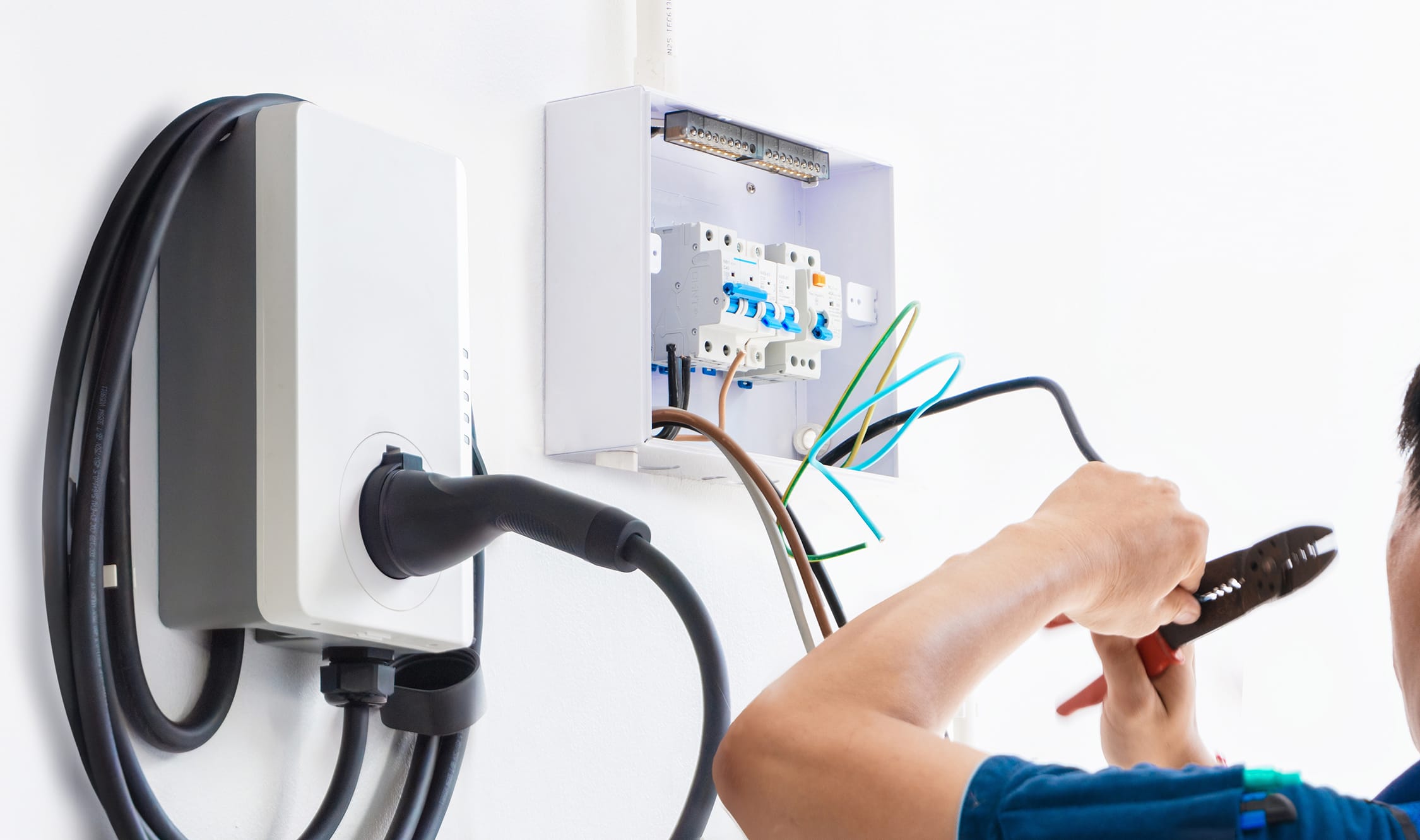
Most New York property owners who call us about commercial EV charging station installation say the same thing: they wish they’d started three months earlier. Between NYSERDA’s Charge Ready NY 2.0 program — which received an additional $15 million in February 2026, bringing its total budget to $28 million — and a federal tax credit set to expire on June 30th, the calculus for waiting has shifted dramatically. The incentives are real. The timelines are longer than most people expect. And the businesses that started planning six months ago are already moving into installation.
So let’s talk about what a commercial EV charging station installation actually looks like, week by week.
Weeks 1–2: Site Assessment and Electrical Capacity
Here’s where commercial jobs get complicated fast. The load calculation isn’t optional — it’s the whole ballgame, because older New York buildings were not built with EV infrastructure in mind and a lot of them hit a wall before you’ve even picked equipment. Sometimes load management software buys you a way out: the system monitors draw across all the chargers in real time and throttles intelligently so you’re not blowing past panel capacity at 8 a.m. when half the fleet plugs in at once. That approach works, but only if it’s baked into the design from day one rather than patched in later. Beyond the electrical piece, the site assessment is really a separate conversation — conduit paths, trenching distances, where ADA requirements create constraints, whether the mounting surface on a particular wall is actually usable. Straightforward in theory. Rarely straightforward in practice.
The site assessment also covers physical layout: where the conduit runs, how far the trenching needs to go, ADA compliance, and whether there are any structural constraints that will complicate mounting. Cable distance and trenching complexity are among the primary factors that affect both installation cost and timeline. A parking lot where your electrical infrastructure is on the far end from your ideal charger placement can add weeks and real money to the project.
Get an EVITP-certified electrician involved here, not just a general contractor who’s “done a couple EV jobs.”
Weeks 2–5: Permitting and Utility Coordination
This is where projects stall. Not because of bureaucratic malice — just the ordinary friction of multiple agencies moving at different speeds.
New York’s Joint Utilities EV Make-Ready Program offers incentives that can cover up to 100% of the electrical infrastructure costs associated with new non-residential EV charging stations, and it comes with a dedicated point of contact who’s supposed to streamline the utility coordination process. Worth using. But “streamlined” is relative — utility interconnection reviews still take time, and if your project requires a new service connection or transformer upgrade, add several weeks to your estimate.
The permitting side runs parallel. Local building permits, electrical permits, and in some cases environmental review. For New York City properties specifically, expect Department of Buildings involvement and possible zoning review if you’re altering a parking structure.
One thing that gets overlooked: New York State Agriculture and Markets Law requires equipment owners to notify the Department of Agriculture and Markets when new public electric vehicle charging stations are installed. Miss this and you’ll be chasing it down after the fact.
Weeks 3–6: Equipment Procurement
You don’t need to wait for permits to finalize equipment selection, but you do need to nail this down before installation begins — lead times on commercial-grade Level 2 equipment are running four to eight weeks depending on the manufacturer. For properties pursuing NYSERDA rebates, there’s an added wrinkle: charging stations must be installed from NYSERDA’s approved equipment and networks list to qualify for Charge Ready NY 2.0 incentives. Verify before you order.
For most commercial applications — offices, multifamily buildings, hotels — Level 2 AC charging is the practical choice. Level 2 commercial chargers deliver between 7.2kW and 22kW, providing 25–80 miles of range per hour of charging, which is plenty for an employee parking for a full workday or a hotel guest charging overnight.
Networked chargers over non-networked, almost without exception. The monitoring, payment processing, access control, and uptime management capabilities aren’t optional in a commercial deployment — they’re how you run the thing after it’s in the ground.
Weeks 6–9: Installation
Actual physical installation is often the fastest phase. Most commercial projects follow a 10–12 week total timeline, with the installation itself being a fraction of that — the long runway is everything that precedes it. Trenching, conduit runs, electrical panel work, mounting the EVSE units, connecting to the network. An experienced crew on a straightforward site can get this done in days. Complex sites with significant civil work take longer.
Working with EVITP-certified electricians and following NEC guidelines is the standard for safety and compliance. Don’t compromise on this to save on labor costs — inspection failures and rework are far more expensive.
Weeks 9–11: Inspection, Commissioning, and Incentive Filing
Final inspection covers circuit sizing, ground fault protection, and code compliance. Once that clears, the system goes live — but live doesn’t mean done. Commissioning involves verifying network connectivity, setting up payment and access configurations, testing each port, and confirming the management software is pulling real-time data correctly.
Then comes incentive filing, which has its own deadlines. For Charge Ready NY 2.0, post-installation applications must be submitted within 90 days of installation, with all documentation submitted at once. The per-port rebates — $3,000 per port at workplaces, multifamily properties, and hotels, with an additional $1,000 per port at sites in Disadvantaged Communities — are meaningful. Don’t leave them on the table because someone missed the filing window.
The federal Section 30C tax credit is a separate filing entirely. This credit covers 30% of hardware and installation expenses, up to $100,000 per commercial unit, for projects placed in service before June 30, 2026. Talk to your accountant now, not after installation.
The Honest Bottom Line
Complex sites requiring electrical upgrades can push timelines well past the standard 10–12 weeks. Budget for that. Budget for the permitting delays too. The businesses that start this process in April and May are the ones realistically positioned to capture both the Charge Ready NY 2.0 rebates and the federal credit before it expires.
The infrastructure isn’t going to install itself. Neither are the rebate applications.

 4770 White Plains Road, Bronx, NY
 info@efficiencyplus.co
 929.429.3720