
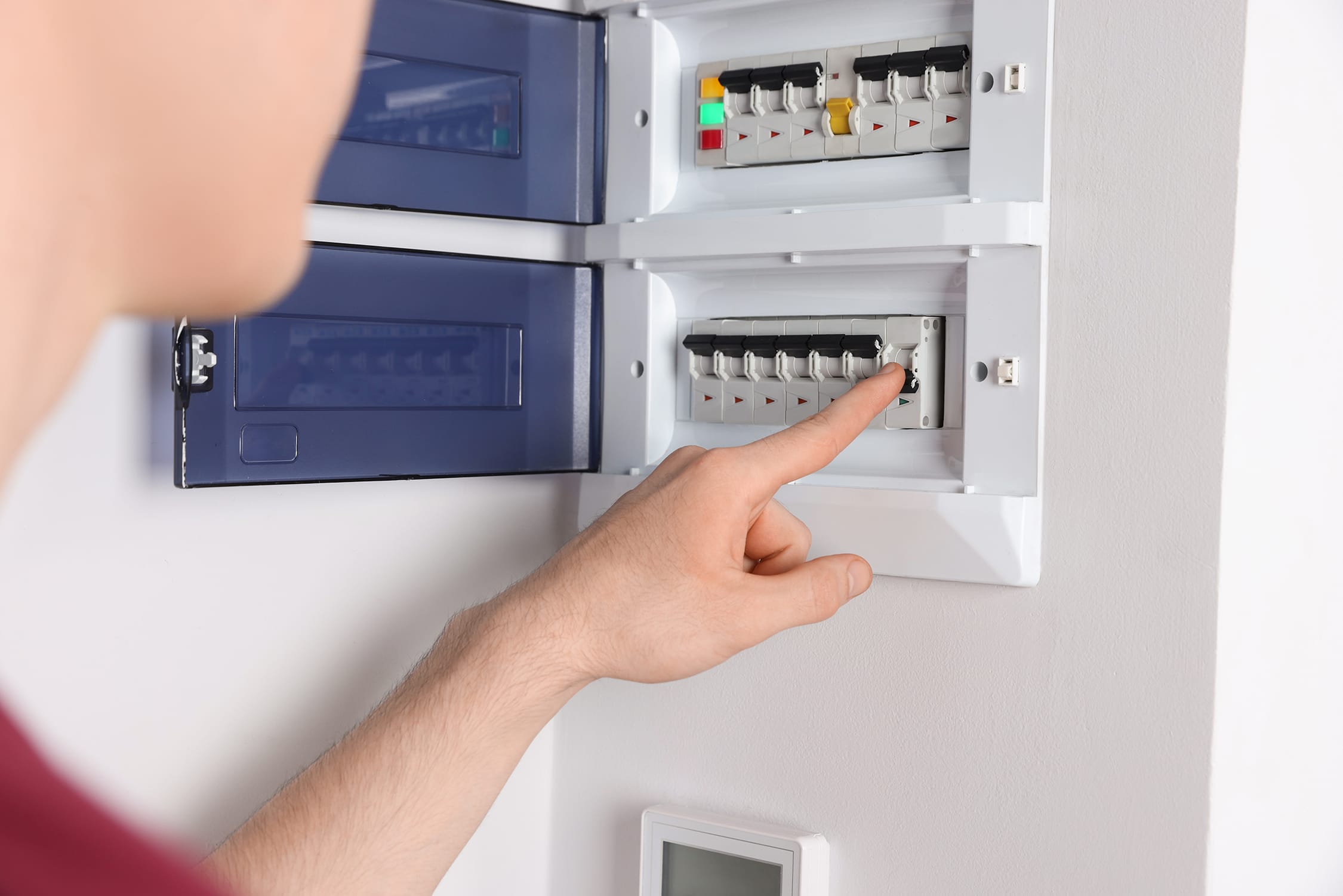
The assumption that installing home EV chargers automatically require panel upgrades is wrong about 80 percent of the time. According to data from Qmerit — the installation network that BMW, Ford, and Tesla route customers through — only about one in five homes actually needs meaningful electrical work before a charger goes in. The rest need a new dedicated circuit, some wire runs, and not much else.
That 20 percent still represents a lot of houses. New York complicates this somewhat — a lot of the housing stock here is old enough that 200-amp service was never part of the original build. The 20 percent figure may run higher in certain neighborhoods. Still, the right move is a real assessment, not a preemptive assumption that the panel needs replacing.
What the panel rating really says
Central air, electric water heater, dryer — that’s already most of a 100-amp panel right there. A Level 2 charger isn’t a light fixture; it’s pulling 30 to 50 amps for several hours straight. Whether there’s room for that is something an electrician calculates, not eyeballs. The stamped number on the breaker tells you the ceiling. It doesn’t tell you how much of that ceiling is already taken.
A 200-amp panel doesn’t guarantee adequate headroom either. The relevant question isn’t just total capacity — it’s how much of that capacity is already spoken for. An electrician performs a load calculation under NEC Article 220 to answer that question precisely: total existing demand versus available panel capacity versus what the charger will add. That calculation, not the nameplate amperage, is the actual diagnostic. Any contractor who quotes a full panel replacement without running those numbers first is skipping the most important step.
When the upgrade is genuinely necessary
There are clear scenarios where an ev charging electrical panel upgrade can’t be avoided. A 100-amp panel with high existing loads is the most common — the math simply doesn’t work. A panel that’s physically full, with no open slots for the double-pole breaker a 240-volt circuit requires, is another. Sometimes a subpanel solves the slot problem without requiring a full service upgrade, depending on whether the main panel still has electrical capacity to feed it.
Then there’s the panel condition issue, which is separate from capacity entirely. Federal Pacific Stab-Lok panels and Zinsco panels have well-documented safety problems — fire risk concerns that predate the EV conversation by decades. If a home has one of these, the upgrade was already warranted. EV charging just makes it more urgent. A panel that’s been running for 30-plus years is a different situation regardless of what the load numbers show — corrosion, outdated breaker components, wiring that’s been spliced and re-spliced over multiple renovations. The capacity might pencil out and the installation still isn’t advisable without addressing the underlying condition first.
The alternatives worth knowing
For homes sitting right at the margin, load management devices have become a practical option. These systems monitor a home’s total electrical draw in real time and reduce the charger’s output when other large loads are active — preventing the kind of sustained overload that trips breakers or stresses the panel. The 2026 NEC code specifically accommodates load-managed EV circuits as an alternative to fully dedicated service, and several manufacturers now build this functionality directly into the charger hardware.
Charging schedules are a lower-tech version of the same logic. Most EV charging happens overnight, and at 1 or 2 a.m. a typical household is drawing very little — no oven, no dryer, HVAC cycling at low demand. The panel headroom at that hour is substantially greater than at peak evening usage. Homeowners who set their charger to start after midnight often find the capacity issue disappears without any electrical work at all.
New York context in 2026
New York has been moving toward mandatory EV-ready infrastructure in new construction — homes built recently are increasingly required to include at least one EV-capable parking space with pre-run conduit. That doesn’t help owners of older homes, but it signals where things are heading.
Con Edison and PSEG Long Island both have off-peak EV charging enrollment programs, and utility rebates for wiring work have been part of the picture in New York. The federal 30C tax credit covers 30 percent of installation costs for residential customers and is set to expire June 30, 2026 — so timing on an installation this year is actually relevant. Eligibility requirements have moved around enough that checking current status with a tax professional before counting on it is worth doing.
NEC 2026 tightened GFCI requirements on EV circuits and made licensed-electrician permitting explicit for permanent installations. New York has required permits on this work anyway, but the updated code gives insurers and title companies something specific to point to when an installation wasn’t done correctly. New York municipalities have generally required permits for this work already, but it matters practically: an unpermitted installation can complicate a home sale and has started generating questions from insurers.
Before agreeing to a full upgrade
A load calculation is a short professional assessment — 20 to 30 minutes for an electrician who knows what they’re doing. It produces a real number: available panel capacity after existing loads, with and without the planned charger. If the first contractor quotes a full panel replacement without performing one, getting a second opinion is a reasonable response.
When an upgrade is genuinely necessary it does add value beyond just supporting the charger — newer panels are more efficient, safer, and better positioned for whatever else gets added down the road. But a significant share of homeowners who get quoted that job don’t actually need it. The load calculation is what separates those two groups.

 4770 White Plains Road, Bronx, NY
 info@efficiencyplus.co
 929.429.3720